Reef Racer: Tips, Strategy & How to Get a High Score
Master the Waves: Reef Racer Strategy Guide
This page provides a comprehensive guide to mastering Reef Racer, an arcade-style underwater navigation game. The most important takeaway is that high scores are achieved by prioritizing pearl collection within “safe zones” of the reef; avoid making desperate, jerky movements for distant rewards, as maintaining a steady path away from the pursuing eels is the only way to survive long enough to climb the leaderboard.
How do I play Reef Racer?
Reef Racer is a fast-paced arcade experience where you navigate a vibrant underwater environment filled with hazards and treasures. The core gameplay loop involves weaving through complex coral structures and jagged rock formations while dodging obstacles that block your path. Your primary objective is twofold: collect as many pearls as possible to boost your score and maintain a significant distance from the eels following behind you. If an eel catches you, the game ends instantly. It combines timing-based navigation with a “collect-em-all” progression system that rewards precision over reckless speed.
The environment is designed to be dense, meaning the space between obstacles is often narrow. You must constantly scan the horizon for the next set of pearls while simultaneously monitoring the proximity of the eels. Every pearl you collect adds to your tally, but every second spent maneuvering too close to a reef edge increases the risk of a collision. Success depends on your ability to process these two variables—reward and hazard—simultaneously as you move through the water.
What controls do I need for Reef Racer?
The controls are designed for instant-play accessibility, making it perfect for quick sessions on both desktop and mobile browsers. You navigate your character by moving left and right to weave through the reef’s obstacles. Because the game is an arcade title, the movement feels snappy; a single tap or click will shift your position enough to dodge a nearby rock or grab a passing pearl.
Because the “path” of pearls often curves, you must react quickly to clusters. If you see three or four pearls grouped together, adjust your trajectory immediately to sweep them up in one smooth motion. Avoid “micro-adjusting”—making tiny, constant movements—as this can lead to oversteering and causing you to collide with the reef edges. Instead, think of your movement in arcs; move toward a goal and stay on that path until the next target appears.
How can I get a high score?
To climb the leaderboard in Reef Racer, you must balance risk versus reward. While it is tempting to dive straight for every pearl, some are placed in “trap” locations—too close to hazardous reef edges where one slight miscalculation ends your run.
Follow these five strategic steps to maximize your points:
- Path Mapping: Look two “screens” ahead. Don’t just react to the current obstacle; plan your lane based on where the next cluster of pearls is located.
- The Safety Buffer: Maintain a consistent distance from the eels. If you see an eel gaining ground, take the safest path possible for three seconds to reset your lead.
- Drafting Pearls: When pearls are grouped together, try to move in a slight arc. This allows you to collect multiple items with a single turn of your movement.
- Speed Management: Don’t panic-move. Sudden, jerky movements can cause you to hit the edges of the reef. Smooth, deliberate turns are safer for long-term survival.
- Focus Zones: Concentrate on the center of the screen. Peripheral vision helps you spot the eels, but your primary focus must be the immediate path ahead.
Which strategies work best for beginners?
If you are new to Reef Racer, start by ignoring the highest-value pearls that are tucked into corners or hidden behind jagged rocks. Many beginners lose their first game because they try to “grab everything” and collide with a rock while turning too sharply at the last second. Instead, focus on the “central path.” By staying in the middle of the navigable area, you create a safety zone where you won’t hit the reef edges, allowing you to collect roughly 80% of the pearls while keeping your survival rate high.
As you gain confidence, you can begin to “hug” the edges of the reef more closely to grab those harder-to-reach gems. However, always ensure there is a clear exit path from the turn you are making. If a pearl requires a 180-degree turn or an extremely sharp pivot, it is usually not worth the risk for your first few rounds.
| Game Feature | Strategy for Success | Difficulty Level |
|---|---|---|
| Pearl Collection | Prioritize clusters over isolated gems | Moderate |
| Eel Evasion | Maintain a 3-second lead at all times | High |
| Navigation | Use smooth, wide turns to avoid reef edges | Easy |
| Speed Scaling | Stay consistent; do not “panic” move | Moderate |
What makes Reef Racer different from other arcade games?
Unlike many underwater racers that focus on top speed or high-octane racing mechanics, Reef Racer is primarily about spatial awareness and navigation. The environment is intentionally dense, and the “obstacles” are often placed in very close proximity to the “rewards.” This creates a tight gameplay loop where every turn counts. You aren’t just racing against a timer; you are navigating a maze that rewards precision and foresight.
Mastering the timing of your turns allows you to glide through the reef smoothly, making it an addictive choice for players who enjoy high-score chasing and reflex-based navigation. While other games might reward “twitch” reactions, Reef Racer rewards “calm” execution—the ability to see a path through the rocks and execute it perfectly without hitting the walls.
Related guides
Play the game
All games →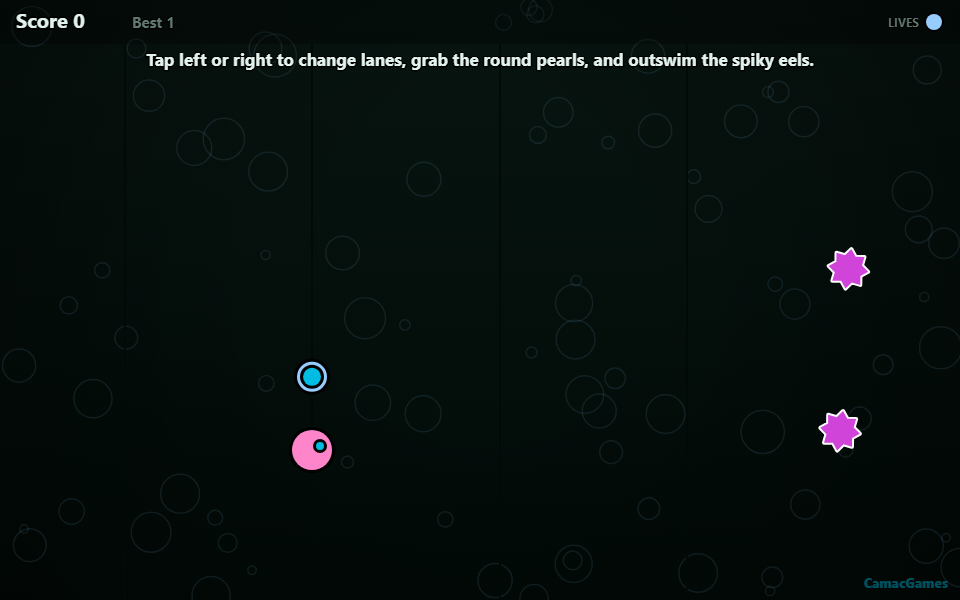
FAQ
How can I get a higher score?
To achieve a high score, focus on maintaining speed while timing your maneuvers perfectly to avoid hazards.
Is Reef Racer free to play?
Yes, Reef Racer is completely free to play directly in your web browser.
What is the best way to navigate obstacles?
Stay alert and anticipate upcoming obstacles by watching the water ahead to maintain your momentum.