Rebound Wall: Tips, Strategy & How to Get a High Score
Master Rebound Wall: Tips, Strategy & High Score Secrets
This page provides a comprehensive guide to mastering Rebound Wall (arcade), focusing on core mechanics, scoring strategies, and advanced techniques. The most important takeaway is that success depends on anticipating bounce angles rather than reacting to current positions; you must position your wall to intercept where the ball will be, not where it currently is.
How do I play Rebound Wall (arcade)?
Rebound Wall is a high-octane arcade experience that blends physics-based puzzles with rapid-fire action. Your primary objective is to protect your goal while using your defensive wall to redirect incoming projectiles. Unlike standard brick breakers, the “rebound” mechanic means every hit counts as both a defense and an offensive maneuver. You must manage the speed of the ball, which accelerates as you successfully deflect it, forcing you to make split-second decisions on how to angle your barrier.
The core loop involves constant movement. As projectiles enter your zone, they don’t just disappear upon contact; they bounce off your wall and travel toward other targets or boundaries. This creates a dynamic environment where one well-placed hit can clear three different threats simultaneously. You aren’t just reacting to the current threat—you are setting up the trajectory for the next three hits in the chain.
What are the best Rebound Wall tips for beginners?
If you are just starting out, focus on “Safe Zones.” Instead of trying to hit every single projectile immediately, prioritize clearing the path directly in front of your goal. This creates a buffer zone that gives you more time to react to outliers.
- Stay Centered: Keep your wall centered as much as possible during the early stages of a level to give yourself a wider margin for error.
- Watch the Velocity: As the game progresses, the ball speeds up. Don’t panic-click; wait for the trajectory to become clear before making your move.
- Chain Reactions: Aim for clusters. Hitting one projectile that is close to another can cause a chain reaction, clearing multiple threats with a single well-placed bounce.
- Predict the Arc: Look at the angle of the incoming object. If it’s coming from a sharp diagonal, your wall needs to be angled slightly toward the center to “flatten” its path.
When you face a cluster of projectiles, don’t aim for the one closest to your goal. Instead, target the projectile that is moving toward the most “crowded” part of the screen. By hitting that specific ball, you can cause it to ricochet into others, clearing multiple obstacles in a single move and buying yourself precious seconds of breathing room.
How can I get a higher score in Rebound Wall?
Scoring in Rebound Wall is tied directly to your ability to maintain momentum and “multi-hit” sequences. To maximize your points, you must transition from defensive play to offensive positioning.
- Combo Multipliers: Hitting multiple targets in rapid succession creates a combo. Stop trying to hit one ball at a time; aim for the densest clusters of projectiles.
- Precision Deflections: If you can deflect a ball so that it hits a boundary or another object before returning to your area, it often yields higher point rewards.
- Speed Management: While the game gets faster, staying calm allows you to hit “perfect” angles, which are rewarded with extra points compared to lucky glancing blows.
To master high scores, focus on the “bounce-back.” If a ball hits your wall and heads toward a corner, it will likely reflect back toward the center of the play area. Positioning your wall to catch that secondary bounce allows you to trigger a double-point event. This requires looking ahead two steps: where is the ball going now, and where will it go after it hits the next surface?
Which controls should I use for Rebound Wall?
The game is designed for instant-play and works seamlessly on both desktop and mobile devices. On a keyboard, you typically use the arrow keys or mouse movement to position your wall. On mobile, the touch interface allows for intuitive dragging of the barrier. Because the gameplay is so fast-paced, precision is more important than speed; a steady hand will always outperform frantic clicking.
| Game Feature | Strategy Tip | Focus Area |
|---|---|---|
| Basic Defense | Center your wall | Survival |
| Cluster Clearing | Aim for groups of 3+ | High Scoring |
| Angle Prediction | Anticipate the bounce | Advanced Play |
| Speed Management | Stay calm as tempo rises | Mastery |
Is Rebound Wall hard to master?
The difficulty curve in Rebound Wall is steep but rewarding. The initial levels provide a buffer for learning the physics of the “rebound” mechanic, but the later stages demand near-perfect timing. As the game progresses, the frequency of projectiles increases, and the speed at which they travel becomes much harder to track visually.
To overcome this, you must stop reacting to the visual “pop” of a ball hitting your wall and start anticipating the geometry of the screen. By mastering the angle of your wall rather than just reacting to the ball’s current position, you can turn a chaotic scramble into a controlled, high-scoring performance. Success comes when you can see the path of the ricochet before it even happens.
Related guides
Play the game
All games →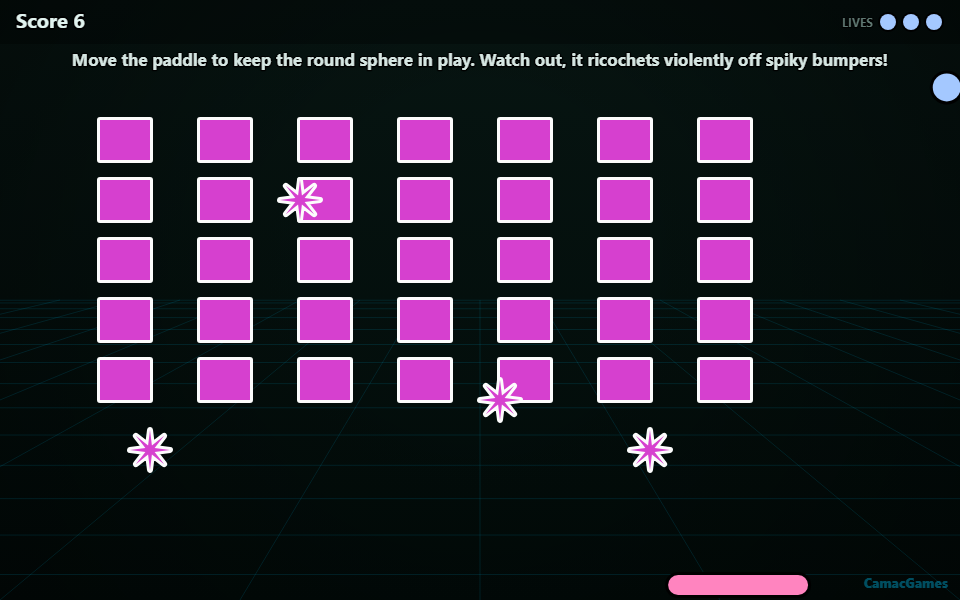
FAQ
How do I get a high score in Rebound Wall?
To achieve a high score, focus on timing your movements and mastering the bounce patterns to avoid obstacles.
What is the best strategy for Rebound Wall?
The best strategy is to maintain a steady rhythm and react quickly to changing wall positions.
Is Rebound Wall free to play?
Yes, Rebound Wall is completely free to play directly in your web browser.