Rain Shield: Tips, Strategy & How to Get a High Score
Master Rain Shield: Tips, Strategy & High Score Guide
This page provides a comprehensive guide to mastering Rain Shield, an arcade-style reflex game where you navigate a vessel through a hazardous storm. The most important takeaway is that success depends on consistent timing; you must balance the aggressive pursuit of water droplets with the defensive necessity of dodging toxic spikes to maintain your score and survive the elements.
How do I play Rain Shield?
Rain Shield is a high-intensity reflex game designed to test your spatial awareness and reaction speed. You control a vessel navigating through a dynamic environment where resources are plentiful but hazards are deadly. The core mechanic involves moving horizontally or vertically to intercept falling water droplets while avoiding “toxic” elements. Unlike slower strategy games, Rain Shield demands constant movement; if you stay still for too long, the game’s rhythm becomes stagnant and your score potential drops significantly.
The gameplay loop relies on a “risk vs. reward” calculation. Every second you spend navigating toward a cluster of water is a second where you are exposed to the falling spikes. To master this, think of the screen as a grid. Instead of reacting only when a spike appears, try to visualize the trajectory of the items before they reach your vessel’s coordinates. This proactive approach allows you to plan your path two moves ahead rather than just reacting to what is currently hitting your hitbox.
What is the best way to dodge toxic spikes?
The toxic spikes are the primary obstacle in Rain Shield. They aren’t just obstacles to avoid; they are “instant-fail” zones that can end a run instantly. To master these, you should adopt a “buffer zone” strategy. Instead of aiming for the center of a water droplet, aim for the outer edges. This gives your character a margin of error if a spike is positioned nearby.
Additionally, learn to read the patterns. While the storm feels chaotic, many spikes appear in clusters or specific lanes. Once you identify these paths, you can subconsciously map out “safe zones” where you can move more freely to collect water without fear of collision. For example, if a vertical column of spikes appears, do not attempt to cross it horizontally unless there is an immediate cluster of high-value droplets on the other side. It is often better to take a slightly longer path through clear space than to risk a “near miss” that results in a game over.
How do I get a higher score?
To climb the leaderboard and beat your previous bests, you must transition from reactive play to proactive positioning. A high score isn’t just about collecting every drop; it’s about maximizing “flow.” When you move with purpose, the game feels smoother, and your eyes can track hazards more effectively.
- Prioritize Pathing: Don’t zigzag wildly for single droplets. If two drops are close together on a straight path, take them both rather than chasing a lone droplet that forces you into a spike zone.
- Maintain Momentum: Keep your movement consistent. Sudden, jerky movements make it harder to react when a new threat appears on screen because they can cause “input lag” in your own mental processing.
- Master the “Near Miss”: In many reflex games of this type, staying close to hazards without touching them builds your confidence in the game’s hitbox system. This allows you to navigate tighter gaps safely.
- Focus on Clusters: Look for areas where multiple water droplets overlap. These are high-value targets that provide a significant score boost in a short window of time.
Which controls should I use?
Since Rain Shield is designed as an instant-play browser game, the controls are optimized for accessibility and speed. Most players will use the Arrow Keys or WASD to navigate. Because the game relies on reflex, your physical setup matters: ensure you have a stable surface and that your keys are responsive.
| Game Feature | Strategy Focus | Primary Control Type |
|---|---|---|
| Rain Shield | Reflex & Timing | Arrow Keys / WASD |
| Water Collection | Path Optimization | Continuous Movement |
| Hazard Avoidance | Spatial Awareness | Rapid Directional Shifts |
Can I play Rain Shield on mobile?
While the game is optimized for browser play, your experience will depend heavily on your screen size and input method. On a mobile device, you must be much more precise with your taps or joystick movements because of the smaller hitboxes. If playing on a phone, it is recommended to use a steady grip to ensure that “dodging” doesn’t result in an accidental tap on the wrong area of the screen.
The primary challenge on mobile is the lack of tactile feedback compared to a keyboard. To compensate for this, try to play in a landscape orientation if possible; this provides a wider field of view and makes it easier to track the falling water droplets across the horizontal axis. If you find yourself hitting spikes frequently on mobile, try to focus exclusively on the center of the screen where the “core” action takes place, rather than trying to reach for outliers that might force your fingers into the edges of the display.
Related guides
Play the game
All games →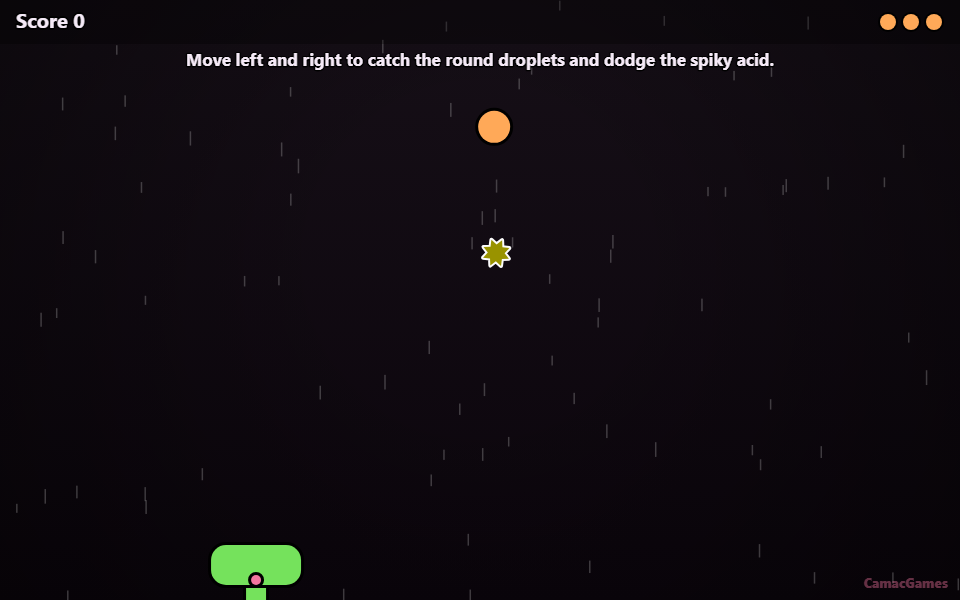
FAQ
How can I get a higher score in Rain Shield?
To achieve a high score, focus on timing your movements and dodging obstacles consistently.
What is the best strategy to survive longer?
The best strategy involves staying centered and reacting quickly to incoming hazards in your path.
Is Rain Shield free to play?
Yes, Rain Shield is completely free to play directly in your web browser.