Puffer Survival: Tips, Strategy & How to Get a High Score
Master Puffer Survival: Pro Tips & High Score Strategies
This page provides a comprehensive guide to mastering Puffer Survival, an arcade game where you navigate the ocean depths as a pufferfish. The most important takeaway for success is mastering the timing of your “swell” mechanic: you must expand your size only when threatened by predators or obstacles to survive while maintaining enough maneuverability to navigate the reef.
How do I play Puffer Survival?
Puffer Survival combines classic arcade mechanics with unique physics-based growth. You control a pufferfish navigating a vibrant underwater environment filled with coral, rocks, and hostile marine life. The core gameplay loop revolves around dodging hazards and managing your physical state. When you are small, you move quickly and can fit through narrow gaps in the coral structures. However, when threatened by larger predators or incoming projectiles, you must trigger your “swell” ability to become large and impenetrable.
The challenge lies in a constant trade-off between defense and mobility. While being puffed up protects you from many attacks, it makes your movement sluggish and limits your ability to navigate tight spaces. For example, if you swell while approaching a narrow crevice, you may find yourself wedged against the rocks, making it impossible to maneuver out of the way of incoming threats. You must constantly analyze the environment ahead; stay small for navigation-heavy zones and only puff up when an immediate threat is within your hit zone.
What are the best Puffer Survival tips for high scores?
To climb the leaderboard and achieve a high score, precision is more important than speed. You need to think several seconds ahead of your current position. Use these specific strategies:
- Zone Awareness: Don’t just react to what is right in front of you. Look ahead at the upcoming coral formations. If a narrow passage is coming up, stay small even if there are minor threats nearby that you can dodge with quick movements.
- Timing the Expansion: Only “swell” when an enemy is within a very close radius. If you puff up too early, you might get stuck against a rock or lose the momentum needed to clear a difficult section of the reef.
- Distance Management: Keep a consistent distance from the edges of the screen. The closer you are to a wall, the less room you have to react if you need to change size suddenly. Aim for the “sweet spot” in the center of the lane.
- Pattern Recognition: Many underwater hazards follow predictable paths. Observe the movement of enemy fish for a few seconds; once you recognize their “loop,” you can time your movements more effectively, allowing you to stay small longer and maintain higher speeds.
Which controls should I use?
The game is designed for instant play, meaning the controls are streamlined for browser accessibility. You primarily use your mouse or touch input to steer the pufferfish. The goal is to create a seamless flow between movement and ability activation.
| Game Feature | Mechanic | Strategy Tip |
|---|---|---|
| Movement | Mouse/Touch | Stay centered in the lane to maximize reaction time. |
| Swell Ability | Click/Tap | Use only as a last resort or against large predators. |
| Size Management | Dynamic | Stay small for speed; stay large for defense. |
How can I beat my best score?
Beating your personal best requires moving beyond “panic” gameplay and into “proactive” navigation. Instead of waiting until an enemy hits you to swell, identify the “danger zones” in the level layout. A pro player treats the swelling mechanic as a tactical choice rather than a reflex.
- Identify the Hazard: Look for red-tinted enemies or fast-moving projectiles that appear on screen.
- Calculate the Gap: Check if there is a narrow opening nearby. If no gap is available, you must prepare to puff up before the threat reaches your hitbox.
- Execute the Shift: Trigger your swell just as the enemy enters your hit zone. This prevents “over-swelling” in areas where movement is restricted.
- Recover: Immediately shrink back down once the threat passes to regain your agility for the next section of the reef.
By mastering the transition between being a nimble, small fish and a formidable, spiked puffer, you can navigate deeper into the ocean and achieve much higher scores in Puffer Survival. Success comes from knowing exactly when to be small enough to move and large enough to survive.
Related guides
Play the game
All games →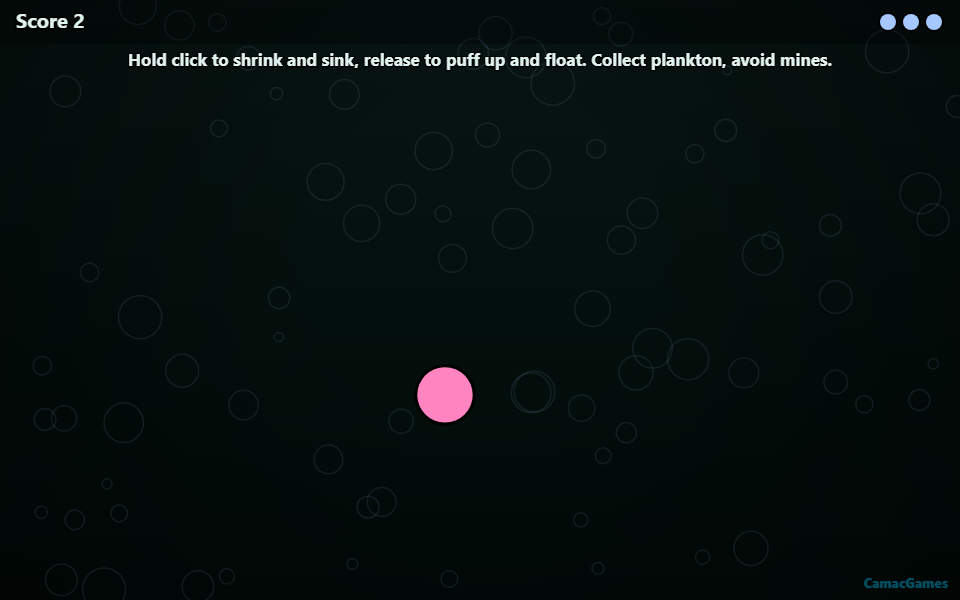
FAQ
How can I get a higher score in Puffer Survival?
To achieve a high score, focus on precise timing and dodging obstacles consistently to stay in the game longer.
What is the best strategy for survival?
The best strategy involves learning enemy patterns and maintaining a steady pace to avoid making fatal mistakes.
Is Puffer Survival free to play?
Yes, Puffer Survival is completely free to play directly in your web browser.