Avalanche Run: Tips, Strategy & How to Get a High Score
Master the Slopes: Avalanche Run Strategy Guide
This page provides a comprehensive guide to mastering Avalanche Run, an arcade-style dodging game. The most important takeaway for achieving a high score is mastering your “safe zone” positioning: staying centered on the screen gives you maximum reaction time and equal distance from both edges, allowing you to navigate the chaotic mountain terrain more effectively at high speeds.
What is Avalanche Run?
Avalanche Run is an intense reflex-based arcade game where you guide a character down a treacherous mountain path. The core gameplay loop involves dodging falling rocks, debris, and environmental hazards while maintaining forward momentum. Unlike traditional platformers that allow for careful planning or pausing, Avalanche Run demands instant processing of visual cues. You must react to the physics of the falling objects in real-time.
The game’s atmosphere is built on tension; as the “mountain” gets steeper (metaphorically), the obstacles become more frequent and faster. Every collision ends your run instantly, making it a pure test of concentration and spatial awareness rather than just luck.
How do I control the movement?
The controls in Avalanche Run are designed for immediate feedback because even a millisecond of input lag can result in a collision. Precision is key to surviving the dense clusters of rocks that appear during high-speed segments.
- PC: Use the Arrow Keys or WASD keys to move left and right.
- Mobile/Tablet: Tap or swipe on the respective sides of your screen to shift your position.
To master these controls, avoid “panic movements.” Many players make the mistake of making large, sweeping movements across the screen when they see a rock. Instead, practice small, deliberate micro-adjustments. If a boulder is approaching from the left, move just enough to the right to clear its hitbox. This keeps you in a stable position for the next obstacle rather than leaving you stranded on the edge of the screen where your options are limited.
What is the best strategy for high scores?
To climb the leaderboard, you must transition from reactive dodging to proactive positioning. Reactive players wait until a boulder is nearly touching their character before moving; pro players scan the “path ahead.” By looking slightly above and in front of your character, you can see where boulders are spawning and begin moving toward a safe zone before the threat becomes immediate.
- Stay Central: Try to stay in the middle of the lane as much as possible. This gives you equal distance to both edges for sudden maneuvers.
- Anticipate Patterns: Many boulders follow predictable arcs or fall at consistent speeds based on their starting height. Identify these patterns early.
- Commit to Moves: If a boulder is coming from the left, move right immediately. Do not hesitate; in reflex games, hesitation leads to collisions.
- Focus on Rhythm: The game often feels like it has a pulse. Try to time your movements to the “beat” of the falling objects rather than reacting to every single rock individually.
Which elements make the game difficult?
The primary challenge in Avalanche Run is the escalating difficulty curve. As you progress, the density of obstacles increases significantly, and the speed at which they fall accelerates. This creates a “tunnel vision” effect where the player must filter out less relevant debris to focus on the most immediate threats.
Furthermore, certain sections of the game feature “cluster spawns,” where multiple boulders fall in a staggered formation. These are designed to catch players who move too early or stay still for too long. To beat these, you must identify the “gap” in the cluster and position yourself within it before the first rock hits your zone.
How does Avalanche Run compare to other reflex games?
While many arcade titles rely on timing a single jump or hit, Avalanche Run tests sustained concentration and spatial awareness over a continuous period of movement.
| Feature | Avalanche Run Focus | Typical Reflex Game |
|---|---|---|
| Primary Skill | Spatial Awareness | Timing/Precision |
| Movement | Continuous Left/Right | Single Action (Jump/Tap) |
| Difficulty Curve | Increasing Speed | Increasing Complexity |
| Key Strategy | Positioning | Rhythm |
How can I practice to improve my reaction time?
If you find yourself hitting rocks too often, focus on these three specific training areas:
- Visual Tracking: Practice following the fastest-moving boulders with your eyes. If you can track their path early, your brain will trigger the movement command sooner.
- Muscle Memory: Play several rounds in a row to get used to the “feel” of the movement keys or taps. This reduces the cognitive load required to move, letting you focus entirely on the obstacles.
- Zone Awareness: Identify which parts of the screen are “dead zones”—areas where rocks frequently spawn—and consciously avoid staying in those spots for more than a split second.
Related guides
Play the game
All games →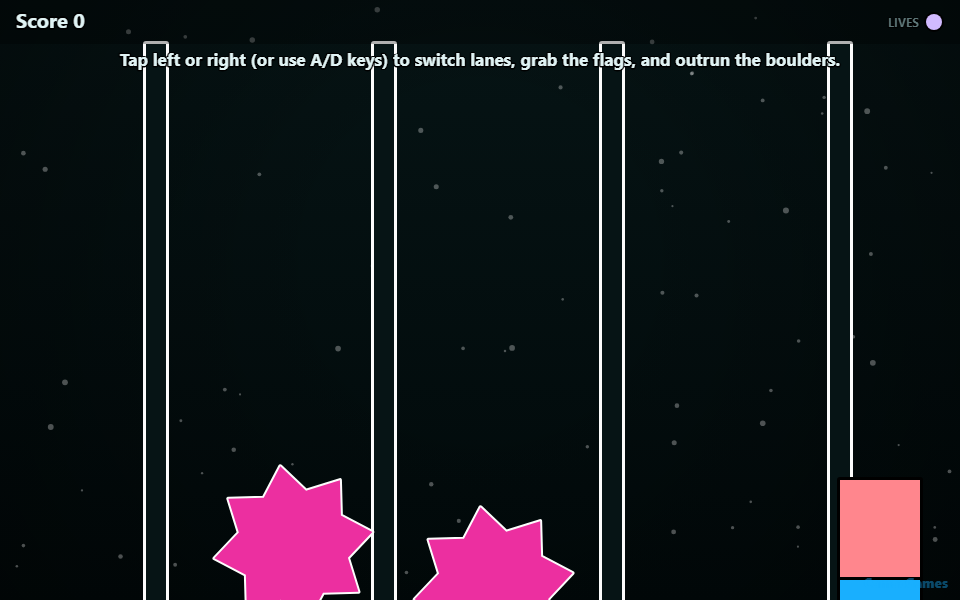
FAQ
How can I get a higher score?
To achieve a high score, focus on timing your jumps and dodging obstacles consistently while maintaining your momentum.
Is it possible to play online?
Yes, Avalanche Run is completely free to play directly in your web browser without any downloads.
What is the best strategy?
The best strategy is to stay centered on the path and react quickly to incoming hazards to keep your combo streak alive.